 Uganda Backs Olara Otunnu for UN's Top Job
  EDITOR'S PICK: WHY MORE INVESTORS ARE ABANDONING NAMANVE AND ESTABLISHING MORE FACTORIES ALONG KATOSI ROAD
  SOUTH KOREA: South Korean AI billionaire faces $1 billion divorce payout for having a child with another woman
  33-Year-Old Former Porn Star Wins Senate Seat
  OUR LOCAL GOVERNANCE SYSTEM DEFINE OUR HISTORICAL ROOTS.
MEACA Calls for Unity in Language and Research at MUST’s EAC Awareness Campaign
By Jarc Tusiime
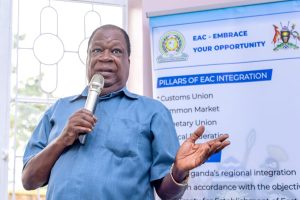
Mbarara, Uganda – The Ministry of East African Community Affairs (EAC) public awareness campaign at Mbarara University of Science and Technology (MUST) was marked by a powerful call for deeper collaboration between academia and the region.
Organized by the Ministry of EAC Uganda under its Department of Production and Infrastructure, the event brought together students, scholars, and policymakers in a dynamic exchange on the future of integration.
Hon. Ikuya Magode, Minister of State for East African Community Affairs, served as the chief guest, while the Chancellor of MUST presided to underscore the university’s enduring commitment to advancing regional unity and development.
The Ministry of East African Community Affairs deployed its technical staff to the university, who engaged directly with students and scholars, answering questions on the complexities of integration and the opportunities it presents. This interactive approach ensured that the campaign was not only informative but also participatory, bridging policy with academic inquiry.
Professor Pauline Byakika Kibwika, in her welcome remarks, highlighted the EAC as a platform for collaboration, knowledge sharing, and collective progress. She emphasized the need for stronger intra-regional research partnerships, noting that while Ugandan universities collaborate extensively with institutions in Europe and North America, collaboration within the EAC remains limited.
“This presents an opportunity to strengthen regional partnerships, promote joint research, and address shared challenges such as health, climate change, and food security,” she said.
Hon. Ikuya Magode, addressing the students and scholars, placed emphasis on the historical formation of the EAC and the urgent need for a common language to foster unity and effective communication across partner states. “The East African Community was founded on the principle of unity, and unity cannot thrive without a shared language. If we are to build a truly integrated region, we must embrace one common language that binds us together,” Hon. Magode stated. He further urged universities to take the lead in shaping this integration by harmonizing curricula, promoting student mobility, and driving innovation that responds to regional needs.
Professor Kibwika echoed this sentiment, calling for harmonized regulatory and ethical review processes across the region, particularly in public health emergencies such as COVID-19 and Ebola.
She stressed that fragmented approval systems delay research implementation, and a coordinated regional approach would improve efficiency and response times.
Leave a Comment
Your email address will not be published. Required fields are marked *